
The first geopolitical flashpoint of 2026 unfolded and concluded within hours, yet its implications could echo for months, if not years.
The recent US military action against Venezuela has been officially framed by the US government as a move against drug cartels allegedly operating with the support of the Venezuelan government and its President, Nicolás Maduro. However, as with most geopolitical events, it is important to look beyond the immediate headlines.
Venezuela holds the world’s largest proven oil reserves — approximately 303 billion barrels, exceeding those of Saudi Arabia, Iran, the US, and Russia. Over the last decade, Venezuela’s oil production has collapsed sharply, not due to lack of reserves, but because of long-standing US sanctions, chronic under-investment, and deterioration of oil infrastructure.
An important but less discussed dimension is that Venezuelan oil has increasingly found its way to China over recent years, often at discounted prices and through indirect channels. This has not only strengthened China’s energy security but also gradually diluted the influence of the traditional petrodollar system. Against this backdrop, recent developments can also be viewed as part of a broader new-age Cold War dynamic, where energy flows, currency dominance, and geopolitical influence are being actively re-shaped. Reasserting influence over large oil-reserve nations could, over time, help reinforce the dominance of the US dollar in global energy trade.
Following the attack, US President Donald Trump’s statement that the US would “run Venezuela”, combined with escalating protests in Iran and his subsequent comments indicating US support for Iranian protestors, suggests that 2026 may witness a meaningful reordering of geopolitical priorities, particularly in regions central to global energy supply.
If one steps back, a broader pattern begins to emerge.
Both Venezuela and Iran are among the largest oil-reserve holding nations globally, yet both remain constrained by international sanctions. Any scenario — even hypothetical — where control, influence, or sanctions frameworks shift, could unlock substantial crude oil supply that has remained off the global market for years.
Markets often react to expectations well before reality. As a result, crude prices may move downward on supply expectations alone, even as geopolitical escalation can simultaneously trigger sharp upward spikes. In short, volatility cuts both ways.
This is unfolding at a time when the world is already navigating:
-
the Russia–Ukraine conflict
-
US tariff-related tensions
-
the China–Taiwan strategic standoff
Adding Venezuela now — and potentially Iran later — introduces another powerful variable into global crude, equity, and commodity markets.
From an Indian perspective, it is worth noting that India remains largely removed from the direct geographical and political epicentre of these developments. In fact, any sustained softening of crude oil prices could be structurally positive for the Indian economy, improving fiscal balance, current account dynamics, and corporate profitability. Additionally, greater access to sanctioned oil supplies, including Venezuelan crude, if and when permitted, could further strengthen India’s energy security.
What appears increasingly clear is that the first half of 2026 is shaping up to be a period of heightened geopolitical churn, where information, perception, and power dynamics may shift rapidly — sometimes within hours.
As investors, the key takeaway is not to predict outcomes, but to recognise the environment:
-
Expect sharp moves
-
Expect conflicting narratives
-
Expect volatility on both sides — upward and downward
We do not seek to forecast directional moves. What appears reasonable to expect is elevated volatility across asset classes.
Long term growth story of India is intact and in such phases, Systematic Investment Plans (SIPs) and Systematic Transfer Plans (STPs) in Equity Mutual Funds should be increased as much as one comfortably can, allowing investors to benefit from volatility rather than fear it.
Asset allocation will and always remain the cornerstone of long-term wealth creation, and investors should consider adding Multi Asset Allocation Funds to their portfolios to balance exposure across Indian equity, international equity, debt, and commodities such as gold and silver during uncertain times.
Volatility is inevitable, but disciplined investing remains timeless.
The past year has been one of the most eventful in recent memory for both the global economy and Indian equity markets. Global shifts, geopolitical challenges, and bold domestic reforms have shaped the path of our markets. Yet, amidst all the volatility, India’s story remains one of resilience and opportunity.
Global Shifts: “Buy China-Buy US”
In September 2024, China announced a $3.5 trillion stimulus package, which immediately diverted global capital flows towards Chinese equities available at attractive valuations. This triggered a wave of “Sell India–Buy China” trades.
Soon after, Donald Trump’s return to the White House in November 2024 boosted confidence in US markets, particularly Tech and AI sectors. Global allocations rushed into the US, leading to continued outflows from India and other emerging markets.
By January 2025, Trump’s focus on geopolitical tensions (Russia–Ukraine, Israel–Hamas) and his new tariff regime added fresh layers of uncertainty. India eventually faced 50% cumulative tariffs—a development that many saw as near-sanctions due to our imports of Russian oil.
Indian Resilience: Three Big Reforms in a Year
While global uncertainties were rising, India delivered powerful domestic reforms:
- Tax relief: Nil income tax up to ₹12 lakhs annual income, putting an estimated ₹1.2 lakh crore back into the hands of taxpayers.
- Monetary push: RBI cut interest rates sharply by 1%, signalling strong pro-growth intent.
- GST reforms: Rationalisation reduced compliance burden and lowered costs, boosting both consumption and business sentiment.
Together, these steps reflect the government’s clear focus on driving GDP growth and supporting domestic demand.
Market Dynamics: Domestic Investors Step Up
Despite heavy FII outflows of nearly – ₹3.75 lakh crore over the past year, Indian markets have displayed remarkable resilience.
- Mutual Fund SIPs are now at record highs of ₹27,000+ crore per month.
- Contributions in Equity Markets from EPFO, insurance funds, and retail investors have further stabilised the market.
- Even with such foreign selling pressure, the Sensex is only ~6% below its peak, while mid- and small-cap indices are down ~10–14%.
The Turning Point: From Resilience to Growth
The outlook is turning decisively positive:
- S&P upgraded India’s sovereign rating to BBB, recognising structural reforms and macro stability.
- Early signs of improved US–India trade dialogue are visible.
- Domestic consumption is rising, and valuations have corrected to fair levels from earlier expensive zones.
- With stability returning, FII inflows are expected to resume over the next 12–15 months.
What This Means for Investors
We are entering a phase where the market will be a “stock-pickers playground”—with frequent sectoral and thematic rotations. Active management will be the key differentiator in wealth creation.
This is the right time to increase equity allocation. We particularly see opportunities in: Multi Cap Funds, Mid Cap Funds & Small Cap Funds. A disciplined approach—through 6-month STPs or long-term SIPs—will help capture the next growth wave while managing volatility.
As interest rates from FDs & Bonds have fallen, investors seeking FD++ returns can look at Balanced Advantage Funds & Multi Asset Allocation Funds for stable and tax-efficient income via the SWP option from these funds.
Closing Note
At Artham FinoMetry, we remain deeply optimistic about India’s equity journey. The coming years present a rare opportunity to participate in India’s structural growth story. Together, let us stay invested, stay disciplined, and create long-term wealth.
🌐 The Big Picture: Trade & Tariffs
Trade is the lifeline of the global economy. When countries exchange goods and services freely, it promotes growth, creates jobs, and drives innovation. However, tariffs—taxes imposed on imported goods—can disrupt this flow, often used by governments to protect domestic industries or address trade imbalances.
In recent months, trade policies have become central to geopolitics. The US-China tariff tensions, ongoing shifts in global supply chains, and regional trade agreements are all influencing the way capital moves—and ultimately how markets behave.
📉 How Do Tariffs Impact Markets?
-
Volatility: Uncertain trade environments often lead to increased market volatility as investors weigh risks and potential disruptions.
-
Sector-Specific Effects: Export-oriented sectors like IT, pharma, and manufacturing are particularly sensitive to tariffs and trade regulations.
-
Currency Movements: Trade restrictions can lead to currency fluctuations, affecting international investments and commodity prices.
-
Inflation & Interest Rates: Higher tariffs can increase the cost of goods, putting upward pressure on inflation—and possibly interest rates.
📊 But Here’s the Bigger Picture: India
Despite concerns around tariffs, India enjoys several macroeconomic tailwinds that make this a compelling time for long-term investors:
- Relatively Lower Tariffs than China – This enhances India’s global competitiveness and supports the “China+1” strategy many companies are adopting.
- Fiscal Boost by Finance Ministry – Recent income tax rate cuts provide more disposable income and support consumption.
- Government-Led Capital Expenditure – Infrastructure spending is at an all-time high, acting as a multiplier for job creation and GDP growth.
- Monetary Support by RBI – With rate cuts, ample liquidity, and a larger-than-expected dividend, RBI is fuelling credit growth and market momentum.
- Robust Fiscal Health – India’s fiscal deficit is under control, and banks are in a much stronger position with healthy balance sheets and improving NPA levels.
- Forecast of an Above-Average Monsoon – This bodes well for rural demand and the agri economy.
- Lower Crude Prices – A major relief for inflation and India’s current account balance, benefiting consumers and businesses alike.
📈 What Should Smart Investors Do?
-
Stay Diversified: Markets react to global events quickly. A well-diversified portfolio across asset classes—Mutual Funds, Bonds, Corporate FDs, and even Alternate Assets—can protect you from overexposure.
-
Think Long-Term: Trade disruptions may cause short-term market corrections, but strong businesses and themes will continue to thrive over time.
-
Focus on India’s Strengths: India continues to position itself as a global manufacturing and digital hub. Sectors aligned with these themes can offer structural growth.
-
Track Global Trends Locally: Whether it’s a sector fund, a global strategy through PMS, or even Start-Up investing—stay tuned into how global events shape local opportunities.
At Artham FinoMetry, our approach is to guide you through changing times with clarity, conviction, and strategic thinking. With access to a wide spectrum of solutions—from Mutual Funds and PMS to Bonds, Insurance, and Start-Ups—we’re here to help you stay ahead.
Trade dynamics and tariffs may bring short-term noise, but with the right strategy, they also open windows of opportunity. Let’s use knowledge as our compass and long-term planning as our anchor.
In 2008, during the worst global financial crisis, Foreign Institutional Investors (FIIs) withdrew Rs.41,000 Crores, and the Indian stock markets crashed by a jaw-dropping 50%. Half the market wealth vanished.
In 2020, amid the global health crisis, FIIs pulled out Rs.58,000 Crores, causing a 20% market drop.
Now, in October 2024, FIIs have withdrawn an even larger Rs.84,000 Crores, yet the markets have fallen by only 5%-6%.
Why??
The answer lies in you. Domestic Institutional Investors — everyday investors like you — have been consistently fueling the market through SIPs and lump-sum investments in mutual funds. Monthly SIP inflows have reached Rs.24,000 Crores, with additional support from insurance companies, EPFO, and retail investors.
This surge in domestic liquidity has created a powerful buffer, keeping the markets stable. Every time FIIs sell and return later, they find themselves buying at higher prices.
This liquidity trend is here to stay, and it’s likely to continue driving the market forward. Invest in Indian Equity Mutual Funds with confidence…
Since late September, we’ve seen the Indian stock market go through a correction, with NIFTY falling around 9%. For many, this drop might seem worrying. But experienced investors know that ups and downs are normal in the stock market.
Every year, the market drops by 10–15%, and every three-four years, it usually falls by 20–25%. Every eight-ten years, a bigger drop of 30–40%+ can happen. These corrections are actually healthy. They help adjust stock prices and give serious investors a chance to buy at better prices.
Looking back over the past 16 years, we see a clear pattern: after each big fall, the market has bounced back strongly. For example, in 2020, despite a 38% drop, the market rose by 86% afterwards. Even smaller drops, like in 2016 or 2019, were followed by solid gains. This pattern reminds us that while declines are temporary, recoveries can bring excellent long-term growth for those who wait patiently.
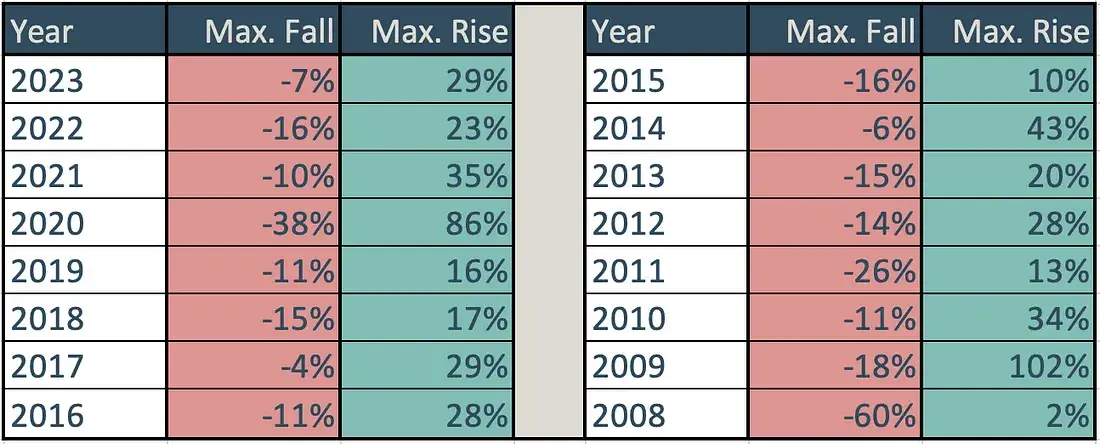
Data compiled by Ms. Niyati Patel at Artham FinoMetry Pvt Ltd. Source: NSE Website, NIFTY 50 Datapoints.
“Investors should see these cycles as part of the journey and not something to fear. Market dips are great chances to build a strong portfolio. History shows that investors who stay calm and keep investing during these times often see higher returns over time.
The rewards come to those who stay calm and disciplined.